
“A pronounced awareness of the stage and physicality is always present in her works; the language is typically gestural, eclectic, and direct — though not without irony and ambiguity.”
-Carl Rosman, Ensemble Musikfabrik
VIDA
by Carl Rosman
Western European concert music has of course benefited from influences further afield for as long as it has existed. During the 20th century, just to speak of neighbors immediately to the east,Stravinsky, Bartók, Ligeti, and Xenakis brought impulses which decisively shaped the western European compositional toolbox. In the early 21st, a steady stream of composers from the former Yugoslavia has made their way to Germany in particular, and although one can hardly still speak of a collective toolbox, the immediate present would be quite different without the contribution of, for example, Sara Glojnarić, Marko Nikodijević, and Milica Djordjević. Misha Cvijović shares their generation and their trajectory; the versatility of her language stems from constant confrontation with varying sonic and artistic perspectives. A keen awareness of stage and physicality is constantly present, in her works whose language is typically gestural, eclectic, and direct — although not without irony and polyvalence.
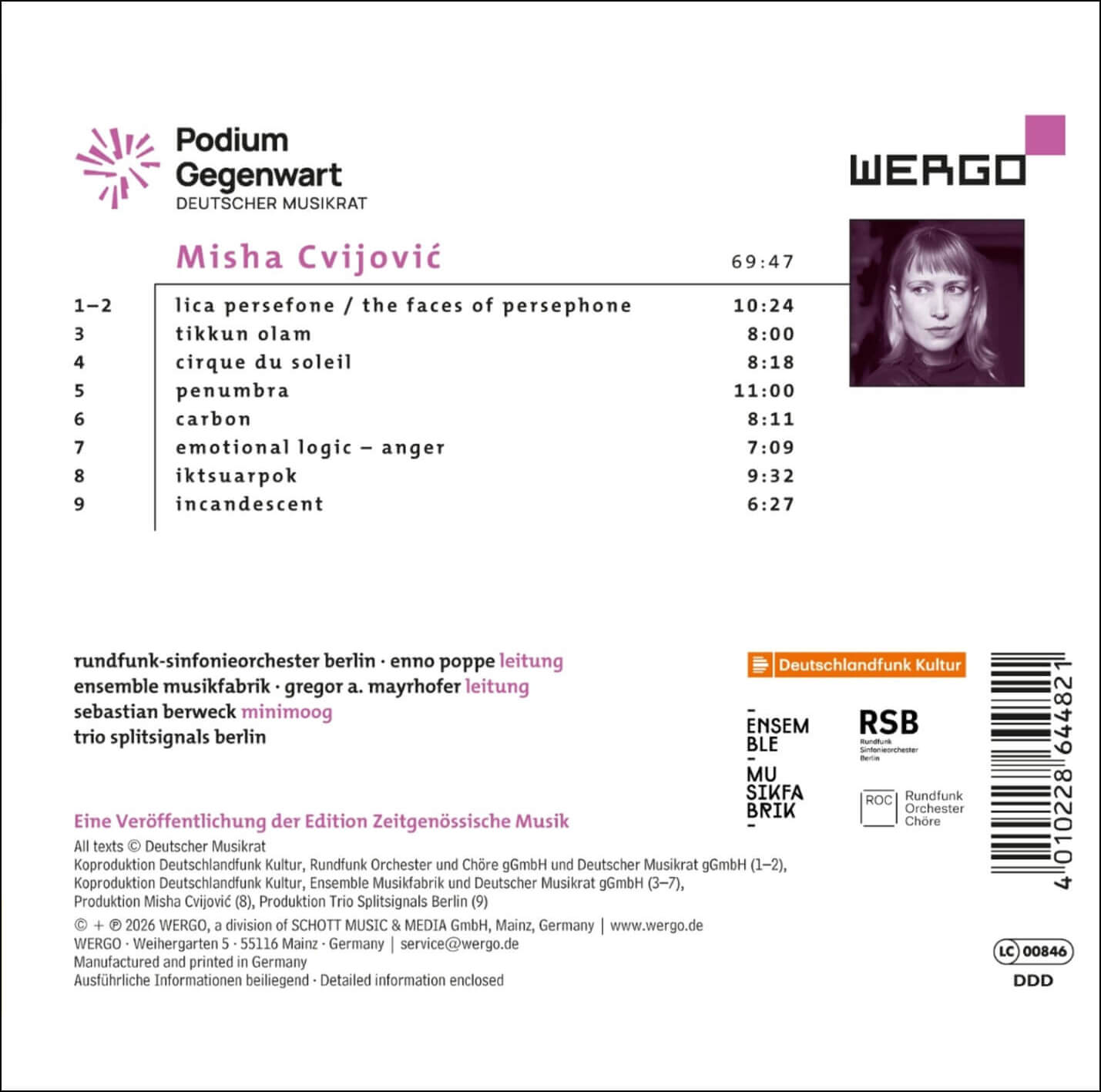
The programme is conceived as a broad triptych. Lica Persefone/The Faces of Persephone, Tikkun Olam and Cirque du Soleil still bear traces of early instrumental and compositional influences; Penumbra, Carbon, and Emotional Logic – Anger take the instrumental palette further beyond the classical mainstream while embracing structured improvisation and and a more adventurous approach to form; Iktsuarpok and Incandenscent shift the focus to the electronic/electroacoustic realm.
The overall title ‘‘Vida‘‘? Spanish for ‘life‘ of course; ‘sight‘ or ‘vision‘ in Serbian (in the genitive case) and an archaic word for ‘healing‘; and a Slavic goddess, Empress of Heaven – but for Cvijović it also denotes a figure far closer to home.
Five of these works were recorded especially for the CD in cooperation with Ensemble Musikfabrik and Deutschlandfunk Kultur. The album also features the Rundfunk-Sinfonieorchester Berlin under the direction of Enno Poppe, as well as Sebastian Berweck on Minimoog and the Splitsignals Berlin trio.